From 17% to 83%: India’s Rural Tap Water Transformation
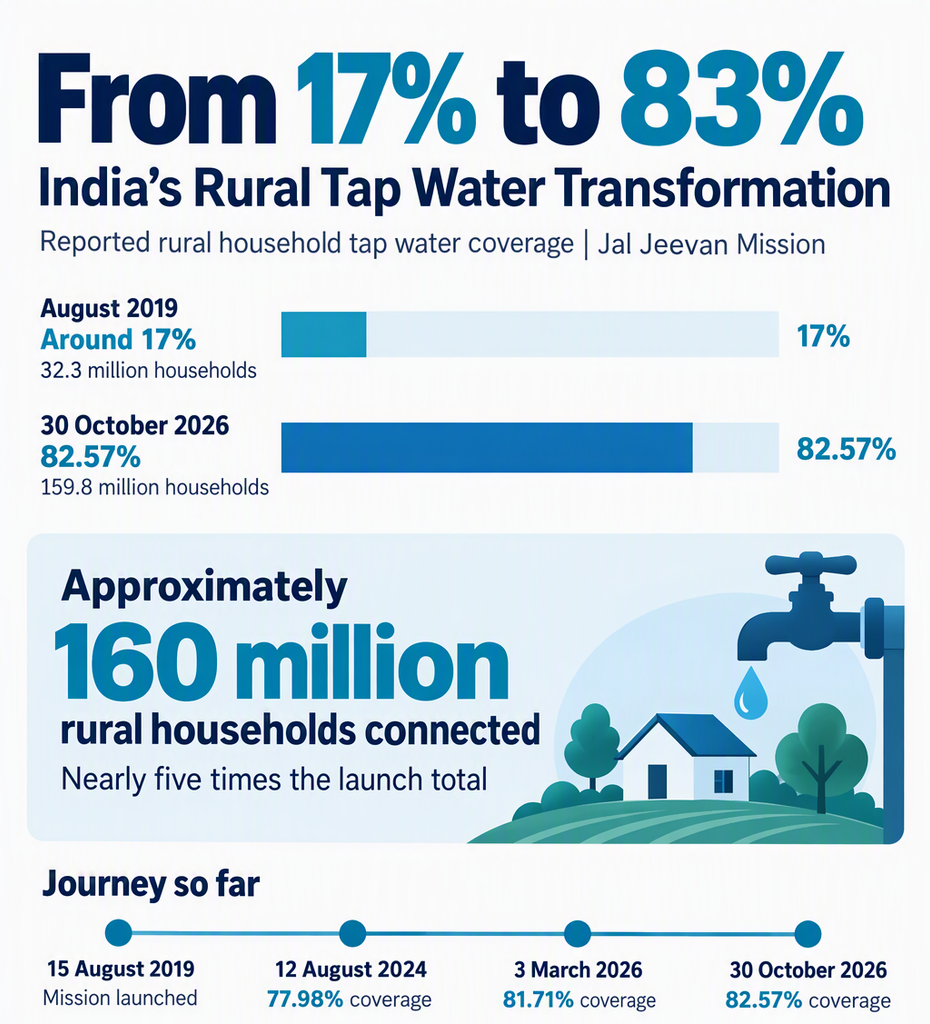
Reported rural household tap water coverage in India has climbed to 82.57%, reaching approximately 160 million households by 30 October 2026, up from around 17% in August 2019. The Jal Jeevan Mission dashboard records 159,804,836 households with tap connections, reflecting a substantial expansion since the programme’s launch. [1, 2]
The total is nearly five times the 32.3 million households recorded at launch, an increase of approximately 127.5 million in just over seven years. Rounded to whole percentages, coverage has risen from 17% to 83%. Yet connection numbers tell only part of the story: reliable supply and water quality remain separate tests of the rollout’s success. [1, 2, 5]
A major expansion in household access
Launched on 15 August 2019, Jal Jeevan Mission set an original target of providing a functional tap connection to every rural household by 2024. The programme combines household connections with village pipelines, drinking water sources and treatment facilities where needed. Its framework also includes water quality monitoring, community participation and maintenance to support lasting service. [2, 3]
Key dates and coverage milestones
- 15 August 2019: Jal Jeevan Mission launched with 3.23 crore rural households, approximately 32.3 million, having tap connections. Official summaries put baseline coverage at around 17%. [2]
- December 2019: Operational guidelines set out the programme’s implementation framework, service requirements and arrangements for managing village water systems. [3]
- 12 August 2024: Reported coverage exceeded 15.07 crore households, approximately 150.7 million, reaching 77.98%. The Press Information Bureau published the figures on 14 August 2024. [2]
- 3 March 2026: Reported tap water coverage reached around 15.82 crore households, approximately 158.2 million, or 81.71%. The Ministry of Jal Shakti published the figures on 2 April 2026. [4]
- 30 October 2026: The dashboard recorded 159,804,836 households with tap connections and 82.57% coverage. [1]
The next challenge: dependable water at the tap
The latest figures leave 17.43% of rural households outside reported connection coverage. Having a connection also does not establish that a household receives uninterrupted supply or water meeting prescribed quality standards. A January 2026 parliamentary response summarising the 2024 functionality assessment reported that, among households with available connections in surveyed villages, 86.5% had working taps, 83.6% received water regularly according to their scheme’s schedule and 76% received water meeting prescribed quality standards. These findings measure service delivery, not national connection coverage. [1, 5]
The assessment surveyed 237,608 households in 19,812 Har Ghar Jal villages across 761 districts and 34 states and union territories. It provides a separate check on service quality rather than a census of all rural homes. State and union territory governments oversee implementation, operation and maintenance, supported by central technical and financial assistance. Repairs, sustainable water sources and routine maintenance remain essential to dependable supply. [5, 6]
The dashboard distinguishes between Har Ghar Jal “reported” and “certified” status. Village certification requires a completion certificate and a Gram Sabha resolution confirming household connections. It documents completion of the rollout, but does not by itself demonstrate uninterrupted service at every tap. [1, 5]
Data note: The figures reflect the live administrative dashboard’s position on 30 October 2026.
Key sources
- [1] Jal Jeevan Mission dashboard, Ministry of Jal Shakti. Snapshot dated 30 October 2026: household connection totals, coverage, certification status and household reconciliation disclaimer.
- [2] Press Information Bureau, “Jal Jeevan Mission: A Milestone in India’s Rural Water Revolution”, 14 August 2024. Launch date, 2019 baseline and coverage as of 12 August 2024.
- [3] Jal Jeevan Mission Operational Guidelines, December 2019. Programme design, implementation framework, service standards and maintenance responsibilities.
- [4] Ministry of Jal Shakti, “Jal Jeevan Mission and Atal Bhujal Yojana”, 2 April 2026. Official statement reporting household coverage as of 3 March 2026.
- [5] Ministry of Jal Shakti parliamentary response, “Assessment of the Functionality of Household Tap Water Connections Provided under JJM”, 29 January 2026. Survey findings, implementation responsibilities and village certification process.
- [6] Jal Jeevan Mission, Functionality Assessment 2024. Official publication page for the national report and state reports on household tap water functionality.