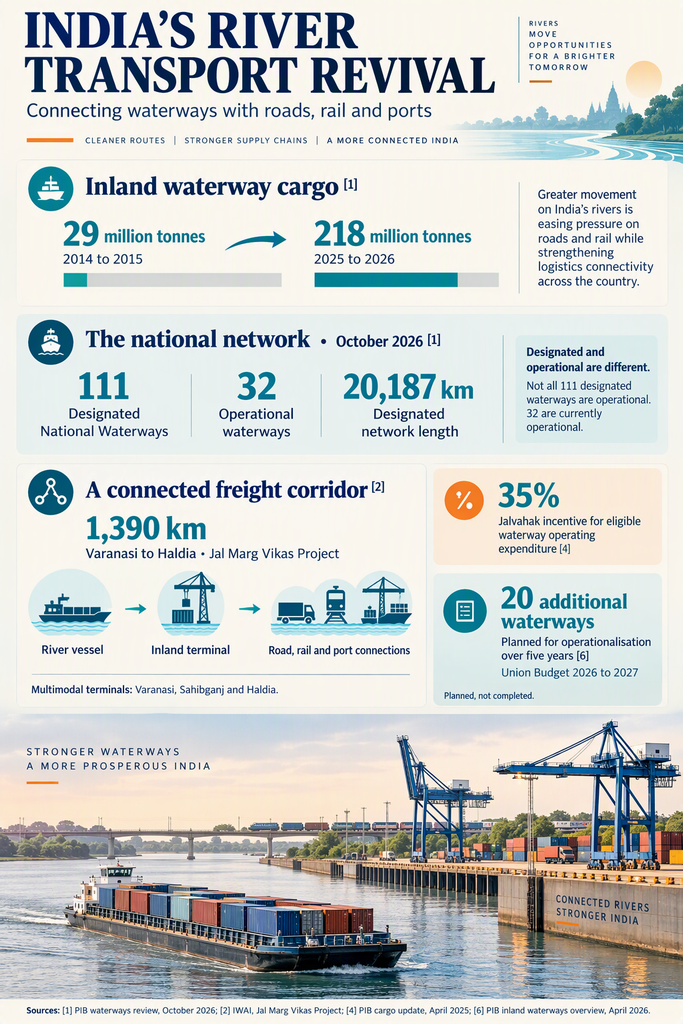
NEW DELHI: India’s rivers are gaining a larger role in the movement of goods, as investment in terminals, navigable channels and digital systems turns inland waterways into a more substantial transport alternative. An October 2026 government review reported inland waterway cargo movement of 218 million metric tonnes in the financial year 2025 to 2026, compared with 29 million tonnes in 2014 to 2015. The latest figure exceeds the 200 million tonne target set under Maritime India Vision 2030. [1]
The shift is not about replacing roads and railways. It is about giving freight another route and connecting rivers more effectively with the infrastructure already carrying India’s trade. Inland vessels can move bulk cargo between industrial areas, inland terminals and coastal gateways, while trucks and trains provide onward connections. This combined approach is central to the development of National Waterway 1 along the Ganga, Bhagirathi and Hooghly river system. [2]
A growing network with a practical purpose
India has 111 designated National Waterways covering 20,187 kilometres across 23 States and four Union Territories. Of these, 32 were operational according to the October 2026 review. The distinction matters: designation establishes the national network, while commercial use depends on navigability, terminals, vessels and demand. The National Waterways Act, 2016 expanded the designated network from five waterways to 111. [1, 3]
The cargo base is already substantial. In its April 2025 announcement, the Inland Waterways Authority of India reported that coal, iron ore, iron ore fines, sand and fly ash accounted for more than 68% of National Waterway cargo in 2024 to 2025. These commodities illustrate the sector’s immediate strength: moving large volumes of materials needed by industry and construction. [4]
Connecting rivers with roads, rail and ports
The Jal Marg Vikas Project is developing a 1,390 kilometre corridor between Varanasi and Haldia with World Bank financial and technical support. Infrastructure developed under the project includes multimodal terminals at Varanasi, Sahibganj and Haldia, an intermodal terminal at Kalughat and a new navigation lock at Farakka. The terminals are designed to transfer cargo between river vessels and land transport, making the waterway part of a connected supply chain rather than an isolated river route. [2]
The World Bank’s January 2026 implementation update reported 85% physical progress, with most assets built under the project already operationalised and traffic increasing following the introduction of scheduled services. At a local level, IWAI also describes more than 60 community jetties supporting passenger movement and cargo connections for riverbank communities. Together, the larger terminals and smaller landing points link national logistics investment with activity closer to home. [2, 5]
Making river transport more dependable
Reliability is essential if businesses are to make waterways a routine transport choice. The October 2026 review describes hydrographic surveys, fairway maintenance and digital platforms providing information on water depth, routes, vessel movements and weather. New riverine lighthouses on the Brahmaputra add navigation support for movement around the clock. These measures address a defining feature of river transport: channels and water levels change with seasons and conditions. [1]
Policy is also encouraging companies to try the river option. Launched in December 2024, the Jalvahak scheme offers eligible cargo owners and movers an incentive equivalent to 35% of actual operating expenditure on the waterway journey. Scheduled services were introduced on National Waterways 1, 2 and 16 through the Indo Bangladesh Protocol routes. The government presents inland water transport as a fuel efficient option that can reduce pressure on busy roads and railways, particularly for bulk and oversized cargo. [4, 6]
The next chapter in India’s transport network
The Union Budget for 2026 to 2027 announced plans to operationalise 20 additional National Waterways over five years. A priority is National Waterway 5 in Odisha, intended to connect the mineral producing Talcher and Angul regions with industrial centres and the ports of Paradip and Dhamra. Training centres and a proposed ship repair ecosystem in Varanasi and Patna are also part of the programme. These remain development plans, but the direction is clear: India is adding river corridors to its expanding transport toolkit. With higher freight volumes and stronger connections to land and sea routes, inland waterways are becoming a practical complement to the country’s highways, railways and ports. [1, 6]
Sources
- Press Information Bureau, Navigating India’s Waterways: Building a Safer, Smarter Network, 16 October 2026. Source for the latest reported cargo total, operational network and navigation improvements.
- Inland Waterways Authority of India, Jal Marg Vikas Project: Capacity Augmentation of National Waterway 1. Details the Varanasi to Haldia corridor, terminals, navigation infrastructure and community jetties.
- Ministry of Ports, Shipping and Waterways via Press Information Bureau, India’s Record Cargo Movement on Inland Waterways, 24 April 2025. Historical context for the expansion from five to 111 designated National Waterways.
- Ministry of Ports, Shipping and Waterways via Press Information Bureau, Cargo Traffic on National Waterways Hits Record High in Financial Year 2024 to 2025, 15 April 2025. Source for cargo composition, Jalvahak incentives and scheduled services.
- World Bank, Jal Marg Vikas Project: Implementation Status and Results Report, 30 January 2026. Independent project update on physical progress, operational assets and increasing traffic.
- Press Information Bureau, A Ride through the Inland Waterways of India, 27 April 2026. Source for transport benefits, the budget’s five year expansion plan and proposed industrial and port connections.