Rising consumption, employment growth and expanded social support helped drive the decline, but regional disparities and uneven access to stable jobs remain.
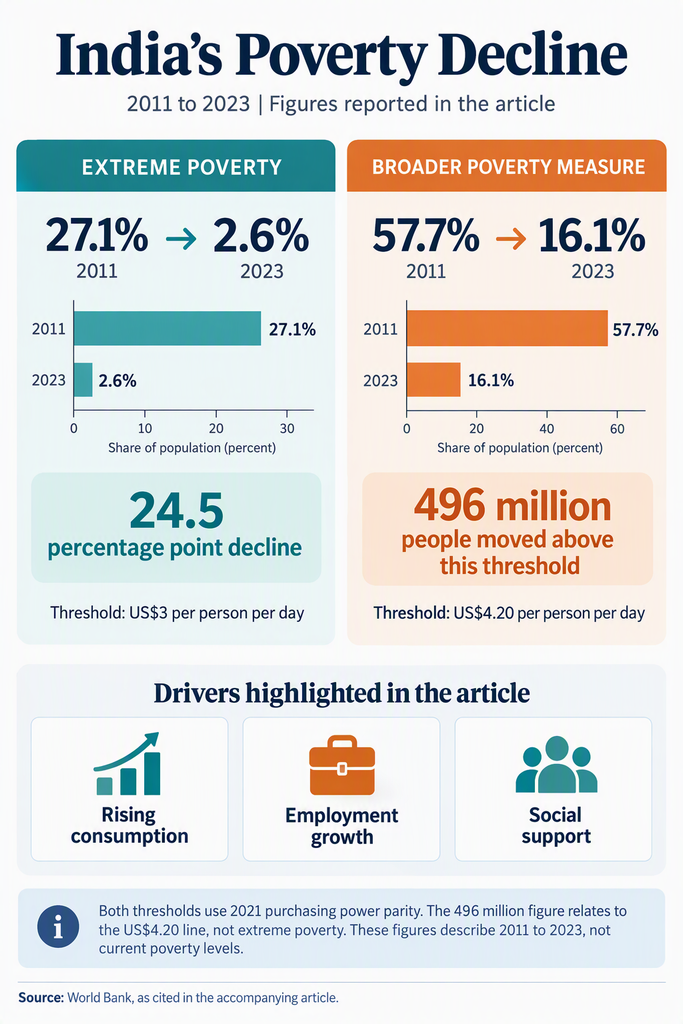
India’s extreme poverty rate fell from 27.1% in 2011 to 2.6% in 2023, according to the World Bank’s October 2026 Poverty and Equity Brief, marking a substantial improvement in living standards over 12 years.
The decline represents a reduction of 24.5 percentage points. The World Bank also estimates that 496 million people moved above its broader poverty threshold for lower middle income countries during the same period, with the share below that line falling from 57.7% to 16.1%.
What the Poverty Figures Measure
The extreme poverty estimate uses an international threshold of US$3 per person per day, expressed in 2021 purchasing power parity terms. The broader measure uses US$4.20 per day. Purchasing power parity adjusts for differences in prices across countries, rather than simply converting local spending at market exchange rates.
The distinction matters: the estimate of 496 million people moving out of poverty refers to the US$4.20 threshold, not solely to extreme poverty. The headline figures describe changes between 2011 and 2023 and should not be read as a measurement of poverty in 2026.
Consumption, Jobs and Social Support Drive Progress
The World Bank attributes the improvement mainly to strong consumption growth, rising employment and expanded social transfers, including food subsidies. Employment increased by about 134 million people between 2017 and 2023, with rural women entering paid work accounting for much of the gain and increasing the number of earners in households.
Both rural and urban households recorded improvements. Faster progress in rural areas narrowed the gap between the two, although many people who remain poor still live in rural communities where productivity is lower and access to better quality employment outside agriculture is more limited.
Regional Gaps and Unequal Earnings Persist
Despite the national decline, poverty remains geographically concentrated. A contiguous belt stretching from Uttar Pradesh to West Bengal accounts for about 57% of India’s poor population, according to the brief. The World Bank says further progress will increasingly depend on expanding productive employment in these states.
Earnings disparities also remain pronounced. Median earnings among the highest earning 10% of workers were about 13 times those of the lowest earning 10% in 2023. Households with less education, fewer assets, limited access to stable employment and more dependants remain particularly vulnerable.
Further Declines Expected, but at a Slower Pace
The World Bank projects that poverty measured against the US$4.20 daily threshold could fall from 14.2% in 2026 to 12.1% by 2028. These are indicative projections based on microsimulations, not observed survey results, and may change as labour market and economic data are updated.
The findings show a substantial reduction in poverty, but not its elimination. Sustaining that progress will depend increasingly on access to productive, stable employment, particularly in rural areas and states where poverty remains concentrated.
More Reading and Sources.
1. World Bank: India Poverty and Equity Brief, October 2026 — Primary report supporting the article’s poverty estimates and projections.
2. World Bank: Poverty and Inequality Platform, India Country Profile — Country data on poverty and inequality.
3. World Bank: June 2025 Update to Global Poverty Lines — Explanation of international poverty thresholds and purchasing power parity.
4. World Bank: June 2025 Update to the Poverty and Inequality Platform — Technical documentation on data updates, India’s survey series and methodology.
5. Government of India: Household Consumption Expenditure Survey, 2023–24 — Official survey release providing context on household consumption and rural and urban spending.